The mall was our weekend destination.
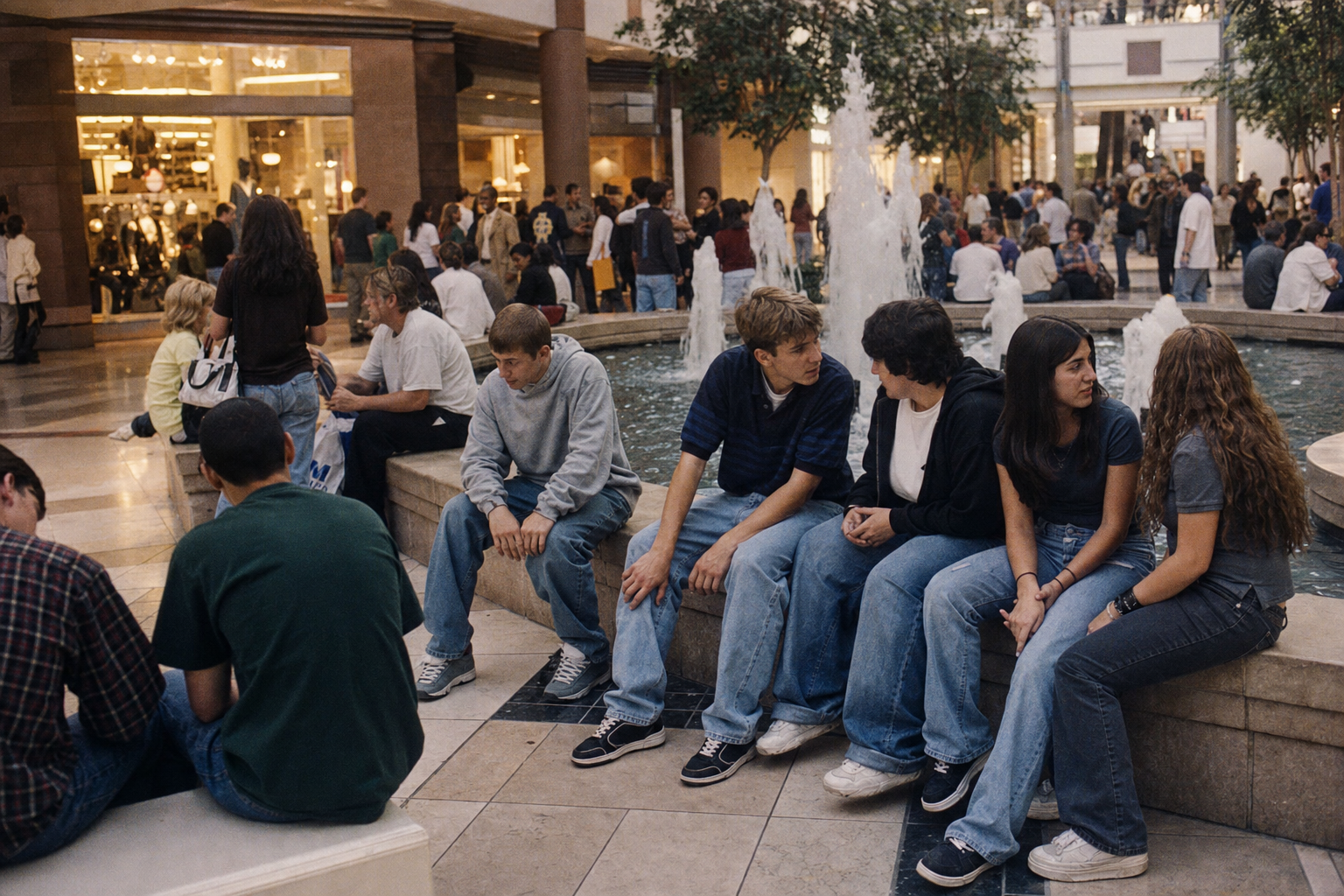
Before anyone called it third place theory, we had a climate-controlled town square with a fountain in it.
You did not go to the mall to buy anything. That was almost the point. You went because it was somewhere to be dropped off, and because it was the one indoor space in a whole town that did not belong to a school, a church, or somebody's parents.
The route was fixed and unspoken. In through the department store, past the perfume counter with your face held carefully neutral, down the main concourse, one full lap. Food court. Second lap. Sit on the fountain edge until a security guard with a radio he never used suggested you not sit on the fountain edge.
Every mall had the same census: the pretzel place, the store that sold posters and lava lamps, the calendar kiosk that appeared in November like a migratory bird, and one anchor store that had been there since the building opened and smelled faintly of carpet and heat.
The economics were terrible and everyone loved it. A group of five kids could occupy a hundred thousand square feet of retail for four hours and generate about nine dollars in revenue, most of it in soft pretzel.
What the mall actually sold was proximity. You went because other people would be there, and the whole afternoon was structured around the possibility of running into somebody. You could not text anyone to find out if they were there. You just went, and looked, and did a lap.
The buildings that survived did it by becoming something else — gyms, clinics, distribution space, a church in the old anchor. The ones that didn't are parking lots with unusually good lighting.
We replaced it with something more efficient and slightly lonelier, which is the sentence you could write about most of the last thirty years.
“It was the only place a fourteen-year-old could go with no money and no reason.”
Otherwise Ordinary publishes original fiction and invented reporting. Names, places and businesses in this piece are made up.