Matchbooks were tiny billboards for a different kind of night.
Free at the register, printed by the thousand, kept for decades in a kitchen drawer nobody opened.
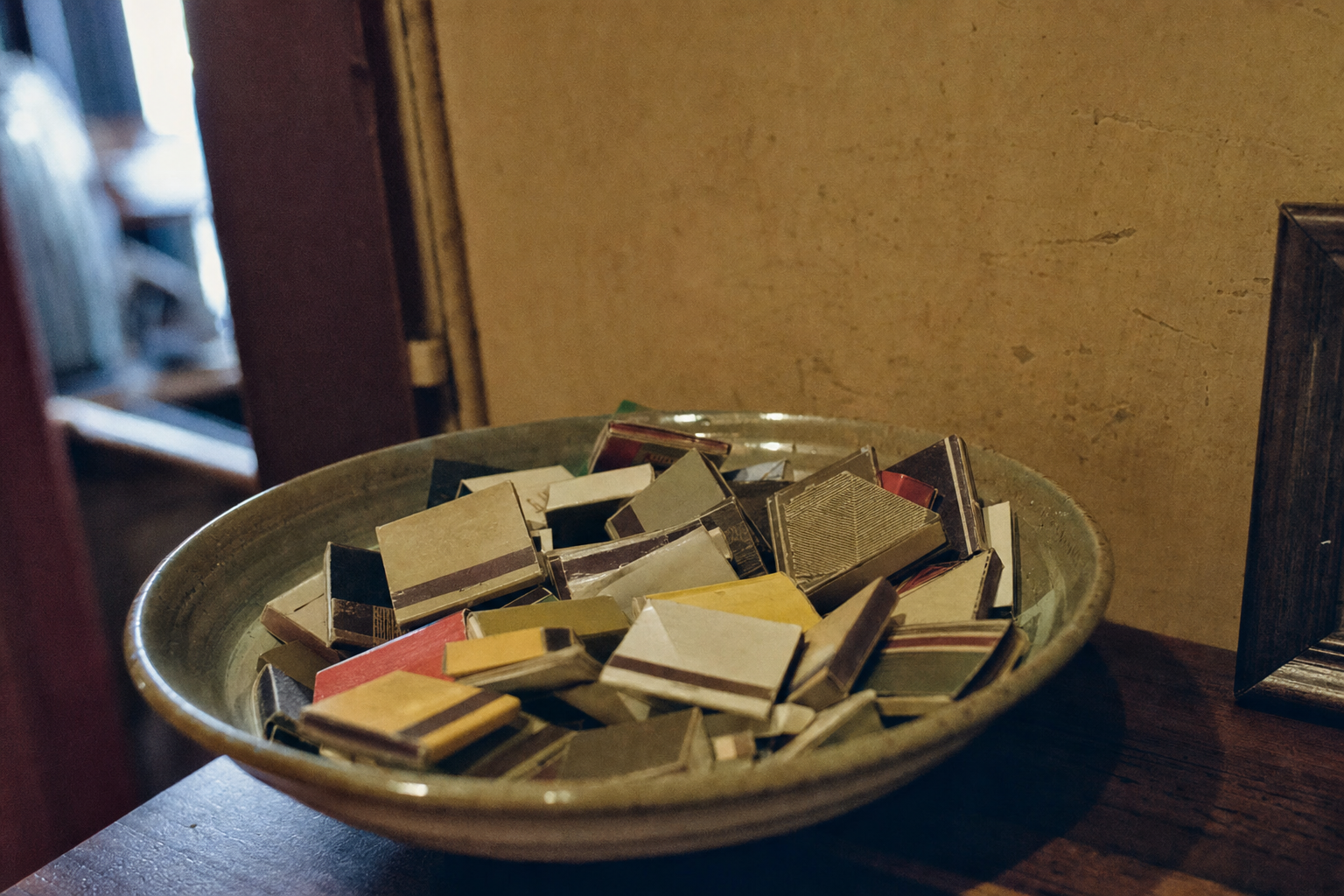
The bowl by the door held matchbooks from places that no longer exist: a supper club, two motels, a bowling alley with a phone number that has only six digits printed on it because the exchange name did the rest.
Matchbooks were the cheapest advertising ever invented. A restaurant ordered ten thousand for less than the cost of a night's linens, put them in a bowl by the register, and let customers carry the brand into their coat pockets and their glove boxes and their kitchen drawers.
They were also, incidentally, an archive. Because nobody threw them away. They cost nothing, they took up no room, and they were mildly useful, so they accumulated in the corners of houses for forty years, quietly recording where a family had eaten.
The design language was remarkably consistent: a two-color logo, a slogan with an exclamation point, a phone number, and on the inside cover, sometimes, an ad for a correspondence school offering to make you a draftsman.
Smoking bans and disposable lighters ended them as a business. What ended them as objects was subtler — we stopped needing physical proof of where we had been, because the record moved to a phone.
The bowl by the door still holds them. The places are gone, the exchanges are gone, the correspondence schools are gone, but the matchbooks remain — not because anyone valued them, but because no one bothered to discard them. We made the archive without meaning to. The past simply preserved itself in the one object we never thought was worth keeping.
“A restaurant gave you a small paper object with its phone number on it and hoped for the best.”
Otherwise Ordinary publishes original fiction and invented reporting. Names, places and businesses in this piece are made up.